A 70-year history of speech recognition: How has the technology evolved?

"What you say becomes text, just like that."
Speech recognition is becoming commonplace these days.
In meetings, speeches are transcribed in real time, and the AI automatically compiles meeting minutes. In interviews, text is created from recorded audio, and in call centers, conversations are analyzed in real time. Furthermore, when combined with generative AI, it is now possible to automatically create summaries, reports, and tasks from audio.
By 2026, speech recognition has evolved from a "technology that converts spoken words into text" into a technology that organizes information based on human voice as a starting point and connects it to the next task.
The history of speech recognition actually dates back more than 70 years.
In an era before AI and smartphones, what kinds of technologies did researchers create to make machines understand human voices?
This article provides a clear, chronological explanation of the history of speech recognition research, from its beginnings to its current integration with generative AI. It explores how "speech recognition," a cornerstone of the AI era, has evolved.
Let's look back on that journey.
A pioneer in speech recognition development (until the 1950s)
Speech recognition has a 70-year history, and its origins are actually somewhat related to the history of the telephone.
In 1876, Alexander Graham Bell invented the telephone, making it possible to convert human voices into electrical signals and transmit them over long distances. Bell Labs was the research and development center that studied this technology. Established as the research and development division of Bell Systems, Bell Labs is known as one of the world's leading research institutions, having produced numerous technological innovations, not only in communications technology but also in transistors, lasers, and more.
The pioneer of speech recognition research was "Audrey," developed at Bell Laboratories in 1952. At that time, it could only recognize numbers from 0 to 9, and even then, it could only recognize the voices of specific people. Nevertheless, the very idea of "a machine understanding human speech" was groundbreaking at the time. This marks the beginning of 70 years of speech recognition history, which leads to the generative AI of today.
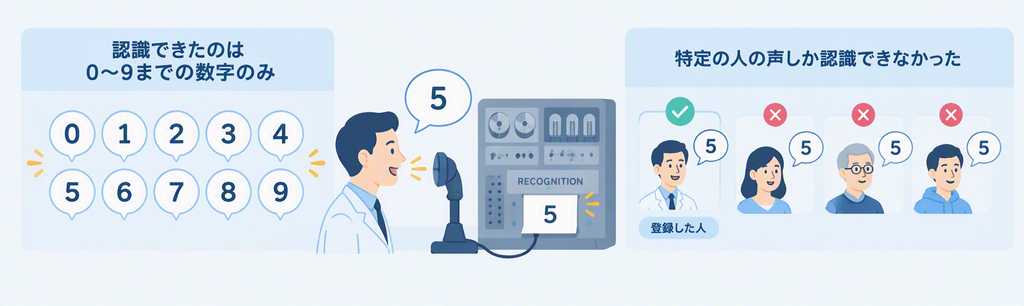
First Generation: The Era of Pattern Matching (1960s)
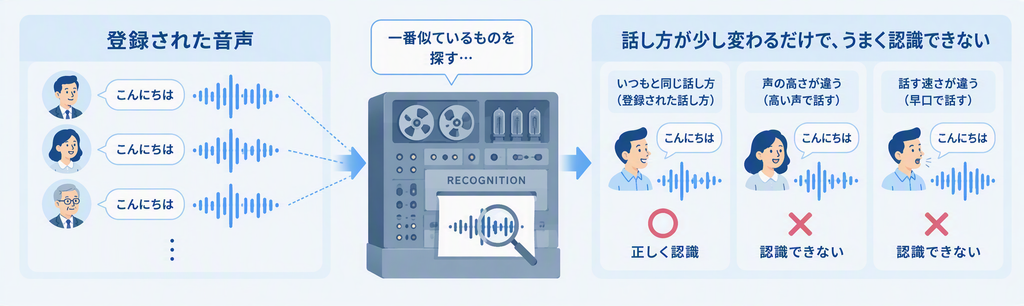
Early speech recognition systems compared registered speech with actual spoken sounds and searched for the closest match.
In 1962, IBM released "Shoebox," which could recognize not only numbers but also simple words. Around the same time, research into monosyllabic recognition was progressing at Kyoto University in Japan, and the basic technologies for speech recognition were gradually being laid.
However, speech recognition technology was still in the research stage at that time.
For example, even the same "hello" can sound different depending on the person, with varying pitch and speaking speed. Even my own way of speaking changes depending on my physical condition and mood, from one day to the next. Computers often struggle to understand these differences, and it wasn't uncommon for them to fail to recognize someone if their speaking style changed even slightly.
"People's voices vary more from person to person than you might think."
That was the first obstacle for the researchers.
Second Generation: The concept of DP matching (1970s-80s)
To solve this problem, a technique called "DP matching (Dynamic Programming Matching)" was developed.
It might sound a little complicated, but the concept is surprisingly simple.
For example, whether we say "thank you" quickly or slowly, we understand that it's the same word.
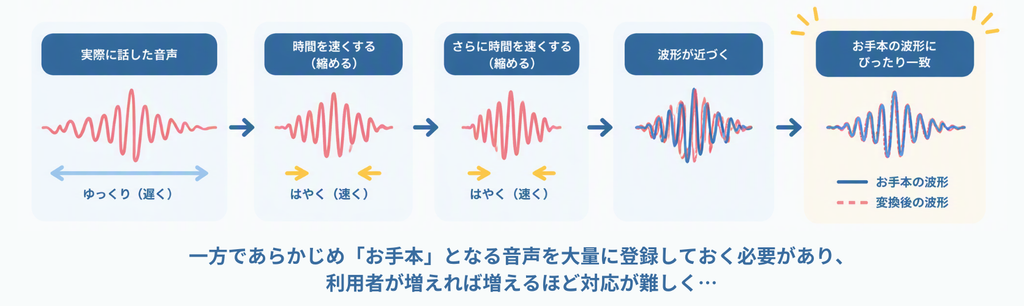
DP matching is a technology that compensates for differences in speaking speed by stretching or compressing audio over time.
Instead of simply comparing sound waveforms as before, speech recognition has advanced significantly by becoming able to determine that "the same words are spoken even if the speaking speed is different."
On the other hand, fundamental issues remained.
This method requires registering a large number of "example" voices in advance. As the number of users increases, the number of examples also needs to be increased, and it was not practical to accommodate the various speaking styles, dialects, and accents of different people.
In other words, the limitations of simply "finding similar sounds" were beginning to become apparent.
Third Generation: The Transition to Statistical Models (1980s–2000s)
This was the era in which speech recognition made a huge leap forward.
Speech recognition technology shifted from "a technology that searches for which example is the most similar" to "a technology that predicts the most likely word."
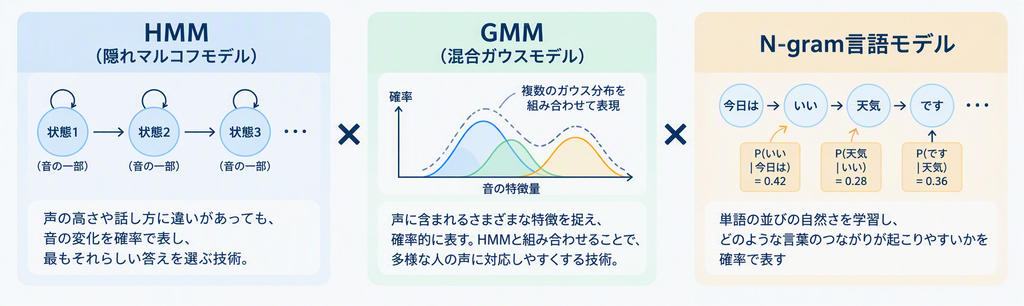
This is where the HMM (Hidden Markov Model), a statistical model, came into play.
This technique allows you to express changes in sound as probabilities, even if there are differences in pitch or speaking style, and select the most plausible answer.
Furthermore, by combining GMM (Gaussian Mixture Model) that expresses acoustic features and N-gram language models that learn the naturalness of sentences, recognition accuracy has improved dramatically.
These technologies have brought speech recognition closer to becoming a technology that can be used not only in research labs but also in real-world work.
Practical applications of speech recognition began to advance in Japan as well, and Advanced Media was founded in 1997. Development of the Japanese speech recognition engine "AmiVoice" was initiated.
The challenge at the time wasn't simply to transcribe Japanese into written form. Each field—healthcare, call centers, parliament, logistics, etc.—had its own specialized terminology and unique way of speaking, and it was necessary to improve the accuracy to a level where it could be used in actual work.
Subsequently, AmiVoice continued to refine its speech recognition technology specifically for Japanese, address these on-site challenges, and advanced toward practical application.
Fourth Generation: The Age of Neural Networks (2010s onwards)
In the 2010s, speech recognition underwent another major transformation.
The driving force behind this was Deep Learning. It was around this time that the term "AI" gained widespread attention.
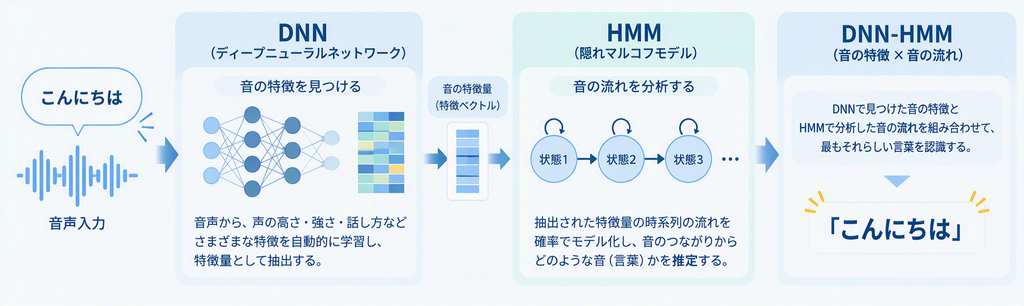
The HMMs used up to that point had limitations in finely distinguishing the unique characteristics of each person's voice. Therefore, the "DNN-HMM" was developed, combining a DNN (Deep Neural Network) to find sound characteristics with an HMM to analyze the flow of sound.
This has significantly improved recognition accuracy.
Many people first experienced this evolution in 2011, when Apple introduced the voice assistant "Siri" to the iPhone 4S, making the experience of talking to your smartphone much more accessible.
In the workplace, work methods that involve recording information without using a keyboard are becoming more widespread, such as creating medical records and meeting minutes, transcribing phone conversations, and voice input in logistics sites.
4.5th Generation: The Era of End-to-End Models (2015-)
Around 2015, the very mechanism of speech recognition began to change again.
Up until then, speech recognition combined multiple mechanisms: "analyzing sounds," "predicting words," and "constructing them into sentences."
The newly introduced End-to-End model represents a novel approach that learns the entire sequence of processes through a single neural network.
Initially, techniques such as CTC*1 and Attention*2 were used, and later, Transformer*3, which is also familiar in generative AI, came to be adopted.
This has enabled more efficient learning from large amounts of data, further improving the accuracy of speech recognition.
AmiVoice has also provided speech recognition APIs in line with the evolution of this technology, and implemented a new engine adopting Transformer in 2023. With the establishment of an environment that enables speech recognition to be integrated not only into proprietary products but also into various applications, opportunities for developers to utilize speech recognition have greatly expanded.
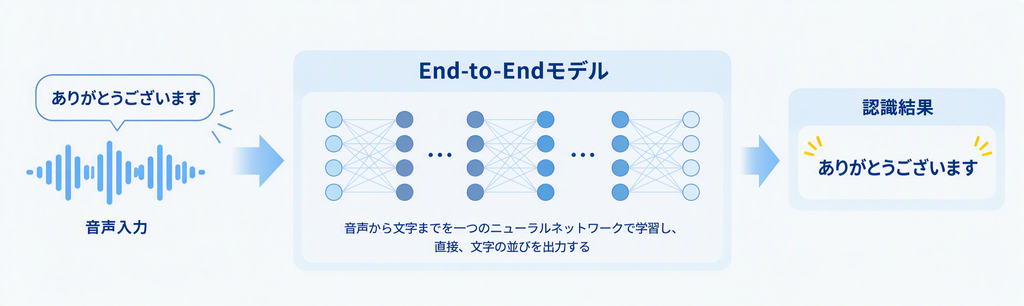
*1 CTC: A mechanism that enables learning the correspondence between speech and characters without the need to specify in detail which part of the speech corresponds to which character.
*2 Attention: A mechanism that predicts the next character while selecting the parts of the speech that should be particularly focused on at that moment.
*3 Transformer: A neural network mechanism that primarily uses Attention to collectively capture the relationships among information contained in speech or text. It serves as a foundation not only for speech recognition but also for the development of generative AI.
Integration with generative AI (2020s to present)
Then, in the 2020s, speech recognition underwent another major transformation.
The catalyst for this was the emergence of generative AI, including ChatGPT.
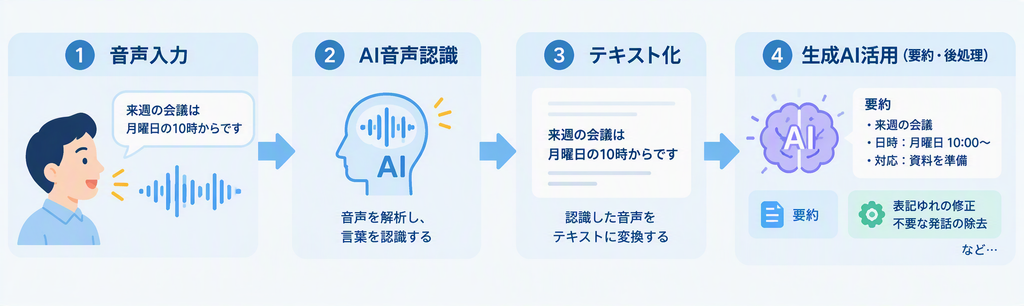
Until now, the basic goal of speech recognition was to "accurately transcribe what was said into text." However, by combining it with generative AI, it has become possible to process things beyond that.
The generative AI now handles everything from summarizing written information and creating meeting minutes to organizing customer interactions and suggesting the next steps to take, all as part of a comprehensive workflow.
For example, in meetings, minutes are automatically created from recorded data. In call centers, systems are also becoming widespread that transcribe conversations with customers in real time, and based on that content, AI suggests possible answers or automatically creates records of the interaction.
In other words, speech recognition is shifting from being a "goal" to serving as an "entry point for delivering accurate information to generative AI."
Conclusion
More than 70 years ago, speech recognition was a technology that could only recognize 10 numbers.
From there, it evolved through pattern matching, statistical models, deep learning, and end-to-end models, and now it has become one of the infrastructures that support our lives and work.
Currently, generative AI is attracting a lot of attention. However, for generative AI to be effective, it is essential that the input information is accurate.
Looking back at the history of speech recognition, the focus tends to be on the "competition to increase recognition rates." However, in reality, it can be said that practical application has progressed by solving each of the challenges specific to the field, such as "Can it understand medical terminology?", "Can it be used in noisy factories?", and "Can it transcribe phone conversations in real time?".
While significant progress has been made in addressing these challenges compared to 70 years ago, ongoing innovations continue to be implemented across different industries and work sites. In this era of generative AI, the value of speech recognition — "accurately capturing what is said" — may be more important than ever before.
From this perspective, the evolution of speech recognition wasn't simply an evolution of the technology that converts speech to text. It could also be said to have been an evolution of the interface that allows humans to interact with computers naturally.
The history of speech recognition is far from over. Further advancements are sure to follow.
| Years | Event |
|---|---|
| 1952 | Bell Labs in the United States announced a digit-recognizing speech recognition system called "Audrey". |
| 1962 | IBM announced "Shoebox," a speech recognition computer. Kyoto University developed voice typewriter |
| 1970s | The "DP matching method" was developed in Japan and the Soviet Union, making sequential word recognition possible. |
| 1980s | IBM and Carnegie Mellon University developed speech recognition based on statistical data by applying "hidden Markov models." |
| 1997 | Advanced Media was founded as a domestic vendor specializing in speech recognition. |
| 2011 | Apple brought Siri to smartphones |
| 2015 | Research into "end-to-end" speech recognition gained momentum. |
| 2017 | Transformer was developed for machine translation (and later used for speech recognition and generative AI). Google and Amazon launch products in Japan, Apple announces HomePod |
| 2022 | OpenAI released "Whisper," a model capable of multilingual speech recognition |
| 2023 | The advent of GPT-4 led to the full-scale application of speech recognition results in conjunction with AI for summarization, analysis, and generative AI. |
| 2025 | As AI agents became more widespread, speech recognition evolved into a technology that can even handle the execution of tasks. |
Related article
Reference
Kawahara, Tatsuya (2018) "The Evolution and Cutting Edge of Speech Recognition Technology," Journal of the Acoustical Society of Japan, Vol. 74, No. 07.
Advanced Media, Inc. "The History of Speech Recognition"https://www.advanced-media.co.jp/en/corporate/history/
Person who wrote this article

Miahara
I joined a speech recognition company and worked in sales, and now I'm studying marketing. I enjoy watching NHK Taiga dramas.
Most Viewed Articles
-
A quick explanation of how speech recognition works!

-
Comparing the speech recognition rates of OpenAI's Whisper and AmiVoice for "conference" audio
-
How to use the AmiVoice API free coupon

New Articles
-
A 70-year history of speech recognition: How has the technology evolved?

-
AmiVoice on kintone - Flying Nimbus and Smooth Wind Ears -

-
Organizing the AmiVoice API manual for AI generation - Providing Markdown and llms.txt files -

Category List
- Introduction to Speech Recognition (18)
- How to Improve Speech Recognition Accuracy (14)
- Tried Building It (28)
- How to Use AmiVoice API (32)
- Comparison and Verification (9)
- Others (11)
Archive