How to Choose a Speech Recognition API: 4 Comparison Points to Avoid Mistakes
When considering implementing a speech recognition API, do you ever find yourself thinking, "All the services say similar things, and I don't know what criteria to use to choose one"?
The applications of speech recognition APIs are rapidly expanding, including meeting minute apps, call center response quality management, automated recording of business negotiations and meetings, and electronic medical record entry in healthcare settings. However, choosing the wrong API can lead to failures such as "words not being recognized at all," "costs being higher than expected," and "not being customizable and therefore unusable in the field."
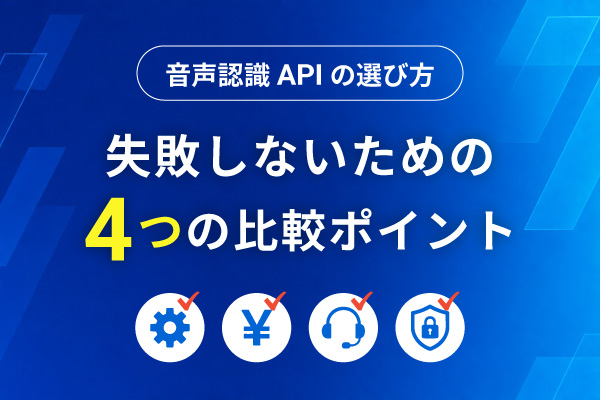
This article explains four essential points to consider when choosing a speech recognition API, from a practical perspective.
What exactly is a speech recognition API?
A speech recognition API is a service that integrates the technology of converting speech into text into applications. When audio data is sent, it is returned as text data, which can then be used for purposes such as recording, sharing, editing, searching, and analysis. Speech recognition APIs are also increasingly being adopted as a "ears" that works in conjunction with generative AI.
Four key considerations when choosing a speech recognition API
When selecting a service, there are many points to verify, but they can be broadly categorized into four key perspectives: "Functions and Performance", "Pricing", "Support", and "Security".
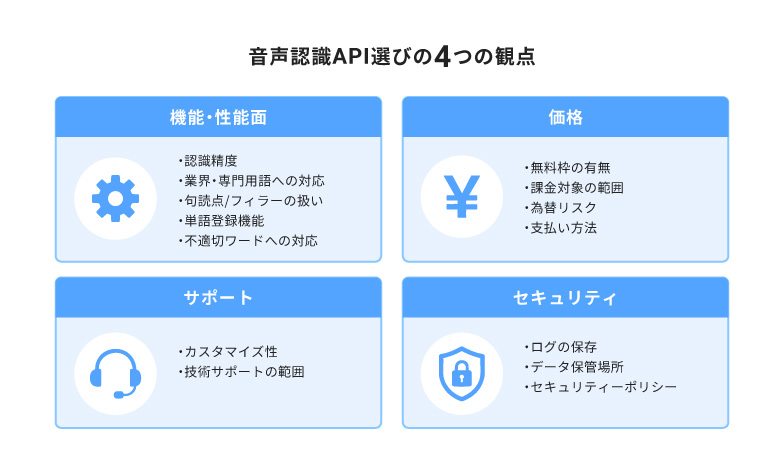
1. Function/Performance
Recognition accuracy
Do not judge based solely on catalog specifications; verify recognition accuracy in actual environments using demos or free trials.
Support for industry and specialized terminology
In settings with extensive specialized terminology such as healthcare, finance, and call centers, general-purpose engines tend to suffer from reduced accuracy. The availability of industry-specific engines is also an important consideration.
Automatic addition of punctuation marks and question marks.
The accuracy of the assignment varies depending on the service, which directly impacts editing costs.
Filler removal
Depending on the use case, it may be better to remove or retain fillers (hesitations such as "um" and "uh"), so it is important that users can choose whether to enable filler removal.
Registering proper nouns and product names
Can I register words along with their spoken form? What is the limit on the number of words I can register? Can I create multiple vocabulary lists?
Handling inappropriate words
Policies regarding the handling of discriminatory language and sexually explicit content, such as hiding, replacing, or flagging it, vary depending on the service.
2. Pricing
Fees / Free‑tier allowance
Since pricing may vary depending on processing speed, don't just decide based on the lowest price; perform a cost simulation tailored to your actual usage.
Scope of charges
Costs vary significantly depending on whether billing is based on total time or only on speech segments. If silent periods are also subject to billing, costs tend to be higher.
Exchange rate fluctuation risk
Please note that the actual cost of overseas services will fluctuate depending on the exchange rate.
Payment methods
Whether a payment method accepts only credit cards or invoices is an important factor for businesses considering its implementation.
3. Support
Customizability
Can it be customized for specific purposes, such as on-premise deployment, language model creation, and speech recognition parameter adjustment?
Technical support
Paid/free service, scope of support, availability of Japanese language support.
4. Security
Log retention and learning utilization
How audio data and logs are stored, and whether or not they are used for model training, are essential points to confirm in highly confidential industries such as healthcare and finance.
Developer / Provider and data storage location
Whether the development company is domestic or overseas, and whether the servers for processing and storing voice data are located domestically or overseas.
How much of a difference will there actually be when comparing them?
Based on the above points, a comparison of the AmiVoice API with 6 major domestic and international speech recognition API services (Companies A through F) reveals the following differences.
| Comparison item | AmiVoice API | Company A | Company B | Company C | Company D | Company E | Company F |
|---|---|---|---|---|---|---|---|
| Display of spoken form #1 | 〇 | × | × | × | × | × | × |
| Word registration function (product names, proper nouns) | 〇 | × | × | 〇 | × | × | × |
| Charges for silent portions of audio data | 0 yen | Paid | Paid | Paid | Paid | Paid | Paid |
| Japanese-language human support under development | 0 yen #2 | Paid | Paid | Paid | Paid | None | None |
| Payment by invoice | 〇 | × | 〇 | 〇 | × | × | × |
*1 Japanese is shown with hiragana, Chinese with pinyin, and Korean with Hangul.
*2 Troubleshooting support for API issues after the production environment is operational is also free.
When compared side by side, the differences between each service become clearly apparent, including features such as custom vocabulary registration, billing for silent intervals, and complimentary staffed support. Among these differences, whether or not silent intervals are billed is a significant point of distinction, as it directly impacts actual operational costs.
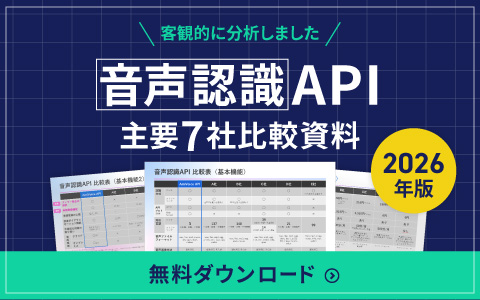
You can review key selection criteria such as pricing (streaming/batch unit costs per 60 minutes), availability of invoice payment options, and support for dedicated environments (on-premises/cloud), as well as differences between each company, in our comparative document covering 7 companies, which can be downloaded from here.
Summary
To avoid making mistakes when selecting a speech recognition API, it is important to compare not only the easy-to-understand criterion of "recognition accuracy," but also detailed specifications that matter in actual operation, such as "Can it recognize industry-specific terminology?" and "We don't want data to leave the country".
We offer a document titled "Comparison Table of Speech Recognition APIs from 7 Major Companies - Key Points for Choosing the Right Service," which compares various companies' speech recognition APIs based on three axes: specifications, functions, and pricing. You can check detailed data such as specific pricing structures, number of supported languages, word registration limits, and billing scope in a single list, so please make use of it if you are in the process of selecting a service.

Person who wrote this article
-

Unagiko
My first encounter with speech recognition was with Seaman. I like trying different kinds of food from different countries.
Most Viewed Articles
-
A quick explanation of how speech recognition works!

-
Comparing the speech recognition rates of OpenAI's Whisper and AmiVoice for "conference" audio
-
How to use the AmiVoice API free coupon

New Articles
-
Organizing the AmiVoice API manual for AI generation - Providing Markdown and llms.txt files -
-
How to Choose a Speech Recognition API: 4 Comparison Points to Avoid Mistakes

-
Things to know before implementation: the accuracy of Japanese speech recognition

Category List
- Tech (1)
- Introduction to Speech Recognition (16)
- How to Improve Speech Recognition Accuracy (12)
- Tried Building It (27)
- How to Use AmiVoice API (29)
- Comparison and Verification (8)
- Others (10)
Archive